Life Forms
From the outset, Rachel Joynt’s work has been characterised by a sense of infinite and the immediate, writes Peter Murray.
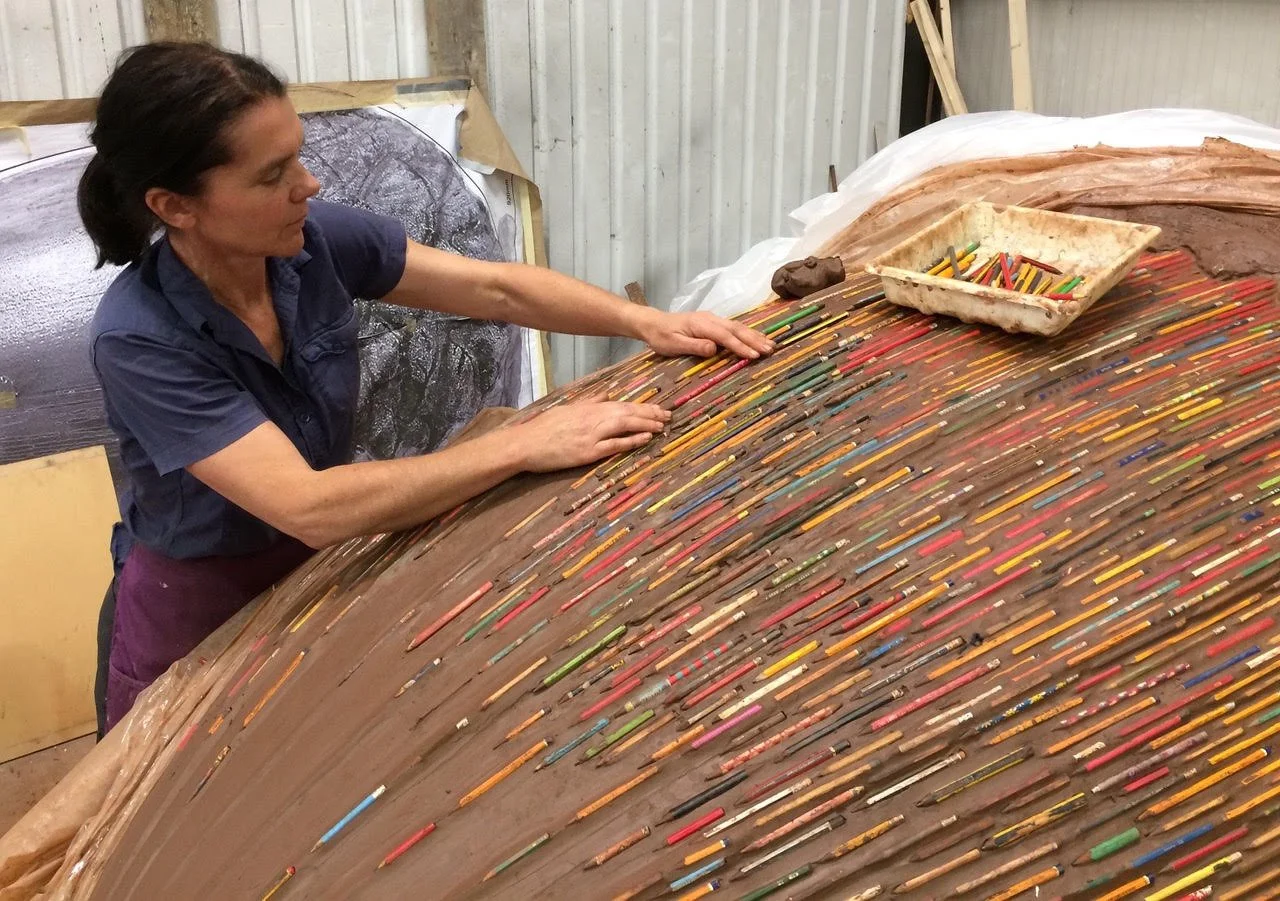
Rachel Joynt's sculpture ranges from Minimalist interventions and installations to large-scale outdoor sculptures. While she specialises in public art projects, she also creates gallery pieces that are finely crafted and engaging. Irrespective of scale, the work is planned and fabricated to a high standard, using materials such as concrete, glass, iron and sand. For the most part, though, Joynt prefers to work with metal, particularly bronze. She is inspired by things that are often overlooked and seeks to portray things that are less visible, 'encouraging the viewer to see through a fresh lens'. Resonant with meaning and memory, her art has a sense of belonging that comes from detailed research and her relationship to a specific place.
There is often a playful aspect to Joynt's sculpture, and a sense of humour evoked through forms and titles - as with Vane as a Peacock (1995) in Dublin Castle, or Love All (2007) a large bronze sphere sited near the tennis club at Templeogue, Co Dublin. Her titles offer partial explanations, allowing the sculpture to develop its own resonances. One of her most impressive works is a large bronze, Dearcán na nDaoine - The People's Acorn (2017), sited in the grounds of Aras an Uachtarain.
Many of Joynt's sculptures, including Noah's Egg (2004), Instinct (2013), Golden Apple (2012) and Love All, are similarly based on curved, ovoid or spherical forms, while bees and beehives inspired two works made in collaboration with fellow sculptor Remco de Fouw, Waggle Dance (2015) at Maynooth University, and the bronze Metropropolis (2018) sited at Central Park Plaza in Leopardstown, Co Dublin.
On a smaller scale, The Whole Story (2009), also an ovoid shell, is perforated with small holes, replicating on a more intimate scale those qualities of engagement and experience that characterise Joynt's large outdoor pieces. The bronze Sea Eye (2014) was inspired by the shell of a sea urchin, while River Goddess (2015), the insides of its shells polished with bright nickel, represents a freshwater mussel opening to reveal a pearl. Extinct in most European countries, freshwater pearl mussels still survive in a few unpolluted Irish rivers.
Cast in bronze using the traditional lost-wax method, works such as Sea Eye and River Goddess, along with Joynt's public art projects, are restful, generous, warm in feeling and free of the anxieties that underlie much contemporary sculpture. Her aesthetic has little relationship with that Western tradition that relies upon vertical elements such as columns, plinths and standing heroic figures. However, there is also a sense in her work - particularly the more recent small pieces - of the present precarious situation, both in nature and in politics. The relationship between a fragile work and its base has become more significant, the block of stone providing stability and protection, as with Attune (Fig 3), Whisper (2019) and In Spire (Fig 5). By referencing eggs, acorns, sea creatures and beehives, often at a microscopic level, Joynt reaches back to the origin of life on earth in both a literal and metaphorical way. Pieces that incorporate screens of glass and sand are more experimental and point to an artist constantly exploring and testing the limits of materials. Incorporating elements of video as well as more traditional pieces, her recent work has been partly inspired by research, assisted by Professor Rob McAllen of University College Cork, into the rich but fragile marine environment of Lough Hyne in West Cork.
Born in Caherciveen, Co Kerry in 1966, Joynt grew up in a family immersed in the visual arts. Although they separated when Joynt was young, both her parents were influential in making their daughter aware of the importance of the creative arts in life. Her mother, Natalie Connolly, attended art college, while her father, Dick Joynt (1938-2002), was a largely self-taught painter and sculptor. He was known for his sculptures in wood, terracotta and, in particular, stone, with works such as The Ram (1994), a large roadside piece in Bray, Co Wicklow. In 1967 the family moved to Dublin.
Dick joined the Dublin Art Foundry, a pioneering enterprise set up in 1970 by John Behan to reintroduce bronzecasting for artists in Ireland, who up until that time had had to send their work to England.
Rachel attended the National College of Art and Design and, while still a student, produced People's Island - Oileán na nDaoine (1988), sited near O'Connell Bridge. Cast in bronze and aluminium, footstep impressions, along with the footprints of birds and dogs, are set into the pavement, following criss-crossing 'desire lines', informal paths of convenience created by pedestrians.
In the early 1990s, Joynt exhibited at the Project Arts Centre in Temple Bar. From the outset, her work has been characterised by a sense of the infinite and the immediate.
Fascinated by the structures and patterns of life, both in human society and nature, even in her early work a sense of place and history was important. Laden with bronze fruit and vegetables, the 1990 sculpture in the form of an old-fash-ioned lamp standard, Solas na Glasraí - The Greengrocers' Light, was sited at the corner of Dublin's oldest open-air food market on Moore Street and Parnell Street. The following year, Woodkey Walk, a work evoking the Viking history of Dublin and consisting of eighteen slabs of granite, bronze and steel, was sited near Christ Church Cathedral. These early pieces were produced at CAST in Church Street, an artists' foundry set up by Leo Higgins and Colm Brennan in 1983.
In 1995, Joynt collaborated with Remco de Fouw to create Perpetual Motion, a hollow ferroconcrete sphere nine metres in diameter, covered with road markings. A simple and memorable sculpture sited alongside a new road in Co Kildare, it was commemorated by An Post last year on a stamp issue.
A few years later, when her first son was born, Joynt created Mothership, a bronze sculpture in the form of a sea urchin tilted on its side, sited on the promenade at Sandycove in Dublin. Joynt researched the shell structures of sea urchins before modelling the sculpture in wax. Having spent many of her childhood and teenage years in Dún Laoghaire, the commission held a special significance for Joynt. It also marked the point when three-dimensional form began to become important in her work. There are subtle allusions in Mothership, including a pattern of metal discs set into the ground, suggesting it has just rolled in on a wave, continuing that sense of movement that has remained a constant thread in her work.
Many of Joynt's sculptures relate to the sea and to rivers. In 1999 she made Shoreline for Strand Road in Derry, while Starboard, a work dating from two years later, is on the banks of the River Lagan in Belfast. Based on the form of a starfish, and appearing to almost cartwheel over the harbour, her cast-iron Guiding Star (2009) is at Port Oriel, Clogherhead, Co Louth.
Three years later, returning to ground-level work, she made Free Flow for the docklands in Dublin, a sculpture involving some nine hundred glass cobblestones that form a pathway alongside the River Liffey, leading from the IFSC to the 3Arena. Some containing bronze and silver fish, the glass cobblestones are underlit at night. As Joynt puts it, 'I like to straddle the fragility of the real and the make-believe, like a frozen moment from a daydream?
Sculptures inspired by rivers and the sea are just part of a practice that has been consistently inspired by life forms in general. In 2004 Joynt's Noah's Egg was sited at Belfield, outside the newly built UCD Veterinary Sciences Centre. Cast in the form of a large egg, this work is again based on detailed research, with the surface of the bronze ovoid evoking the calcium shell of a real egg.
Incorporated into the latticework surface are the forms of sperm from animals such as rabbits, mice and pigs, along with representations of human beings. Small holes perforate the shell, which, when viewed through an aperture, give the effect of a planetarium. At night, Noah's Egg is illuminated by a soft, red light, like that of an egg incubator. Low-key details such as these add layers of reference and meaning to Joynt's work. In 2019, her Cuimbneachán/Keepsake, inspired by the arbutus berries of the Irish strawberry tree (Fig 7), was sited at Lansdowne Place, where Trinity College Botanic Gardens once stood.
Her recent work Siol, a four-metre-tall bronze samara, or helicopter seed, is sited within a reflecting pool at Glencar House in Ballsbridge (Fig 2). The reflection of Sol in the water, creating the illusion of its pair, is an important com-ponent, calling attention to the form of the seed, which appears as if it has just landed. As Joynt puts it, 'I often enlarge what can be unnoticed, make the invisible more visible, the unseen seen.' In the inner courtyard of Glencar House is a related work, Duille Óg (Fig 8), meaning 'new leaf', which takes the form of a sycamore leaf appearing to stand in the water of another reflecting pool.
Joynt's work has not been confined to Dublin and its environs. Inspired by the binding of a book, set into the pave-ment, Spine Path was made in 1994 for the Clare Library headquarters, while in 2012 she made Golden Apple for St Nessan's Community College in Limerick, a bronze sculpture inscribed with lines of poetry. The following year she made Instinct, an ovoid bronze sculpture set beside the River Moy in Co Mayo. A few works by Joynt can be found overseas.
Her Moonwalk (2002), a series of discs set into a prome-nade, is in Morecombe Bay in Lancashire, while Egg (2001) was commissioned by the Cardiff Bay Arts Trust.
Joynt was elected a member of the Royal Hibernian Academy in 2005 and, in 2022, a member of Aosdána. She currently lives and works in the Blackstairs Mountains in Co Carlow. Her forthcoming exhibition, which includes the video Fathom - Invisible Becomes Visible (2025), made with the assistance of her son Louis, marks a new chapter in a career as a creative artist that has already extended over three decades.