Rachel Joynt
PROJECT ARTS CENTRE, DUBLIN
July - August 1993
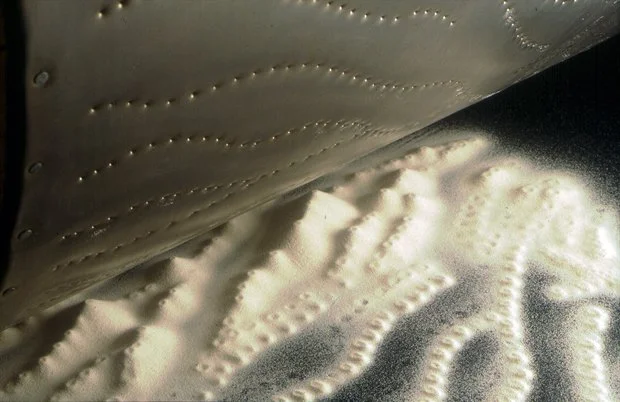
There can be little question that Rachel Joynt's site specific installa-tion at the Project Arts Centre was one of the more successful to be on Essex Street itself, in what may seen over the summer. Beginning arrangement took on a strangely implicit kineticism. Was this simply an illusion? Were the drums truly halted, or were they moving at such a slow pace as to be undetected? Even more to the point, were we simply seeing a kind of freeze-frame that if released would send the drums, momentum and all, crashing into the southern wall?
My initial reaction was to reimagine the entire setup, poised as it was, at the top of a long, long room. With another thirty or forty feet of uninterrupted floor space to roll across, the sense of arrested movement would have been irresistible. As it was, the tension created by this simple combination of elements was astonishingly effective; subtle to the point of being subliminal and yet indisputably assertive all the same. Visitors to the gallery invariably weaved around the drums as if the entire gallery rested on a slight incline, passing them with an understated caution. The drums were approached as if they might suddenly lunge forward and crush the viewer beneath them.
Had I been less arrogant I might well have been intimidated when I subsequently read Joynt's own comments on the show. In giving the piece the name Selene (the moon goddess who had a bad case of the hots for the King Endymion, by whom she had fifty daughters) she had apparently hoped to "suggest connections between aspects of the life cycle, be it micro or macro, psychological or physical ... with a certain ambiguity, curiosity and tension."
Despite having spent some decades immersed in the finer points of gallery-speak, this show, more so than others, seemed far more exciting and substantial than any legitimising bit of text that might accompany it. In recent years though, these stabs at proving an intellectual pedigree have become endemic among artists of all nations and dispositions.
Why? Have critics so abused their own speculative fantasies that artists now feel obliged to mark out their own territory, whatever distortion or reduction it may have on the work itself? Whatever the genesis of this development in our cultural milieu, that tyranny of language and literalism has once again asserted itself. Its effect is deadening and painfully restrictive. In relation to such an evocative work as Selene it distracts our attention from the dynamic reality being offered us.